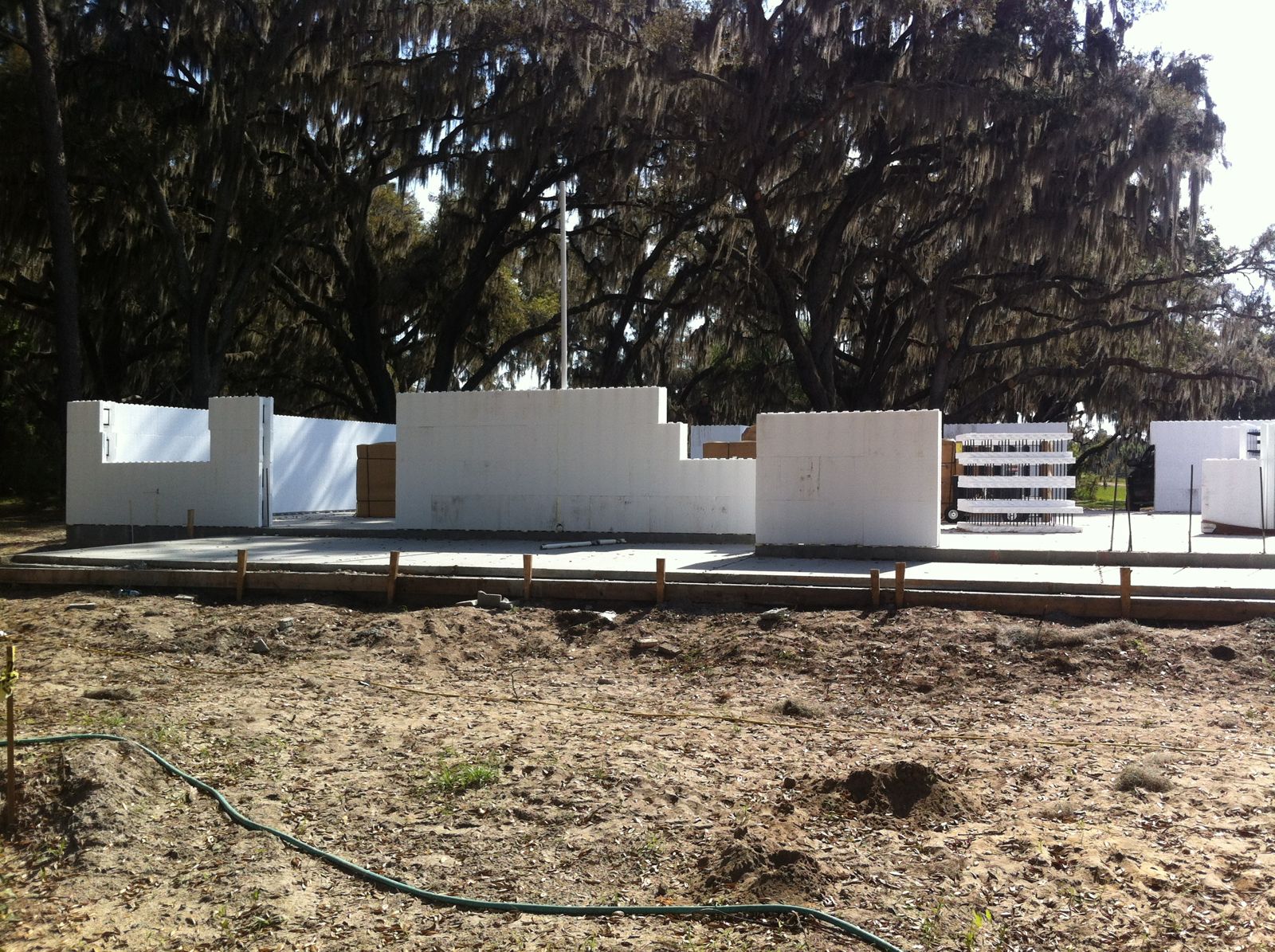
ICF construction has been around Florida for decades, yet the same handful of myths shows up in almost every first phone call we take. Some began as half-truths about early foam products. Others are guesses repeated often enough to sound like facts. We build with insulated concrete forms and nothing else, so we've heard every one of them — and we'd rather you decide based on real information than rumor. Here are the seven myths we hear most, the kernel of truth inside each, and the reality.
Myth 1: "ICF is way too expensive"
The claim: ICF costs so much more than frame or block that it only makes sense for luxury homes.
The kernel of truth: ICF walls do cost more upfront. Industry-wide, the wall system typically adds roughly 3–8% versus block or frame, and every project differs.
The reality: The wall is one line item in a whole budget. ICF walls arrive insulated and sheathed, homeowners commonly save 30–50% on cooling bills, HVAC systems can be right-sized smaller, and storm resistance may lower insurance premiums. Spread over a mortgage, many owners come out ahead. We break the numbers down honestly in our guide to what an ICF home costs in Florida.
Myth 2: "Termites will destroy the foam"
The claim: Florida termites treat EPS foam like a buffet and hollow out your walls.
The kernel of truth: Termites don't eat foam — there's no cellulose in it — but they can tunnel through unprotected foam below grade to reach wood elsewhere in the house.
The reality: The structure itself is solid reinforced concrete, which termites cannot damage at all. The Florida Building Code requires termite protection details on foam below grade, and a competent ICF builder installs them on every project: barriers, treatments, and inspection details that close off the tunneling path. Your framing lumber is at more risk in a wood house than your walls are in an ICF one.
Myth 3: "You can't remodel concrete walls"
The claim: Once the concrete cures, your floor plan is frozen forever.
The kernel of truth: You can't casually knock a doorway through a structural concrete wall on a Saturday afternoon.
The reality: Most remodels touch interior partitions, and in an ICF home those are conventional framed walls you can move like in any house. Only the exterior shell is concrete. New openings in the shell are possible too — they're cut and engineered, the same way openings get added to any masonry building. Good planning up front, including thinking through future additions during design, makes later changes cheaper.
Myth 4: "ICF traps moisture and grows mold in Florida humidity"
The claim: A sealed foam-and-concrete wall can't dry out, so humidity gets trapped and mold follows.
The kernel of truth: Any wall system detailed badly can have moisture problems, and Florida humidity punishes sloppy work.
The reality: ICF has no wall cavity to condense in and nothing organic for mold to feed on — EPS foam doesn't rot and concrete doesn't either. Moisture management comes down to the same things as any Florida home: proper flashing at openings, waterproofing below grade, and an HVAC system sized to actually control humidity. Because ICF homes need smaller, right-sized systems that run appropriate cycles, indoor humidity control is often better than in a leaky frame house with an oversized unit.
Myth 5: "ICF homes look industrial"
The claim: Concrete walls mean a bunker aesthetic — flat, gray, cold.
The kernel of truth: A bare ICF wall before finishes does look like a foam-and-concrete sandwich.
The reality: Stucco, siding, stone veneer, and brick all attach to ICF. Once finished, an ICF home is indistinguishable from any custom home on the street — Mediterranean, coastal, farmhouse, modern. Inside, drywall goes on just like frame. Browse our residential ICF construction work and try to pick out the concrete.
Myth 6: "Any contractor can build with ICF"
The claim: The blocks stack like giant Legos, so any crew can figure it out.
The kernel of truth: Stacking forms genuinely is straightforward. That's part of why the system is good.
The reality: The pour is where experience earns its keep. Bracing, wall alignment, concrete consolidation, embeds, and opening details all have to be right before several stories of liquid concrete go in — mistakes at that stage are expensive and sometimes unfixable. We've seen first-time crews learn hard lessons that an experienced ICF specialist avoids by habit. If you're a builder weighing your first project, our page for builders covers how we take that risk off your plate.
Myth 7: "ICF only makes sense on the coast"
The claim: Unless you're beachfront, hurricane-grade walls are overkill.
The kernel of truth: Coastal wind exposure makes the storm case obvious, and that's where ICF gets the most attention.
The reality: Hurricanes cross the entire state — inland Central Florida takes hurricane-force winds, tornadoes, and falling trees too. And the energy argument has nothing to do with geography: cooling savings, quieter rooms, and fire resistance pay off in Groveland or The Villages exactly as they do in Sarasota. Many of our projects are nowhere near salt water.
How to fact-check any ICF claim you hear
Myths survive because they're rarely challenged. When you hear a confident claim about ICF — for or against — run it through a quick filter:
- Ask for the source. "A guy told me" is not a source. Building codes, engineering data, and utility bills are.
- Ask who profits from the claim. A framer telling you ICF is a gimmick has a schedule to fill.
- Ask someone who has built both. Builders with frame and ICF experience give the most balanced answers.
- Look at real projects. Finished homes, actual energy bills, and homeowners you can talk to beat brochures.
ICF isn't magic and it isn't for every project. But the decision deserves better inputs than recycled myths. Start with the full case for the system on our Why ICF page, then judge it against your own priorities: storm safety, energy bills, quiet, and how long you want the house to last.